

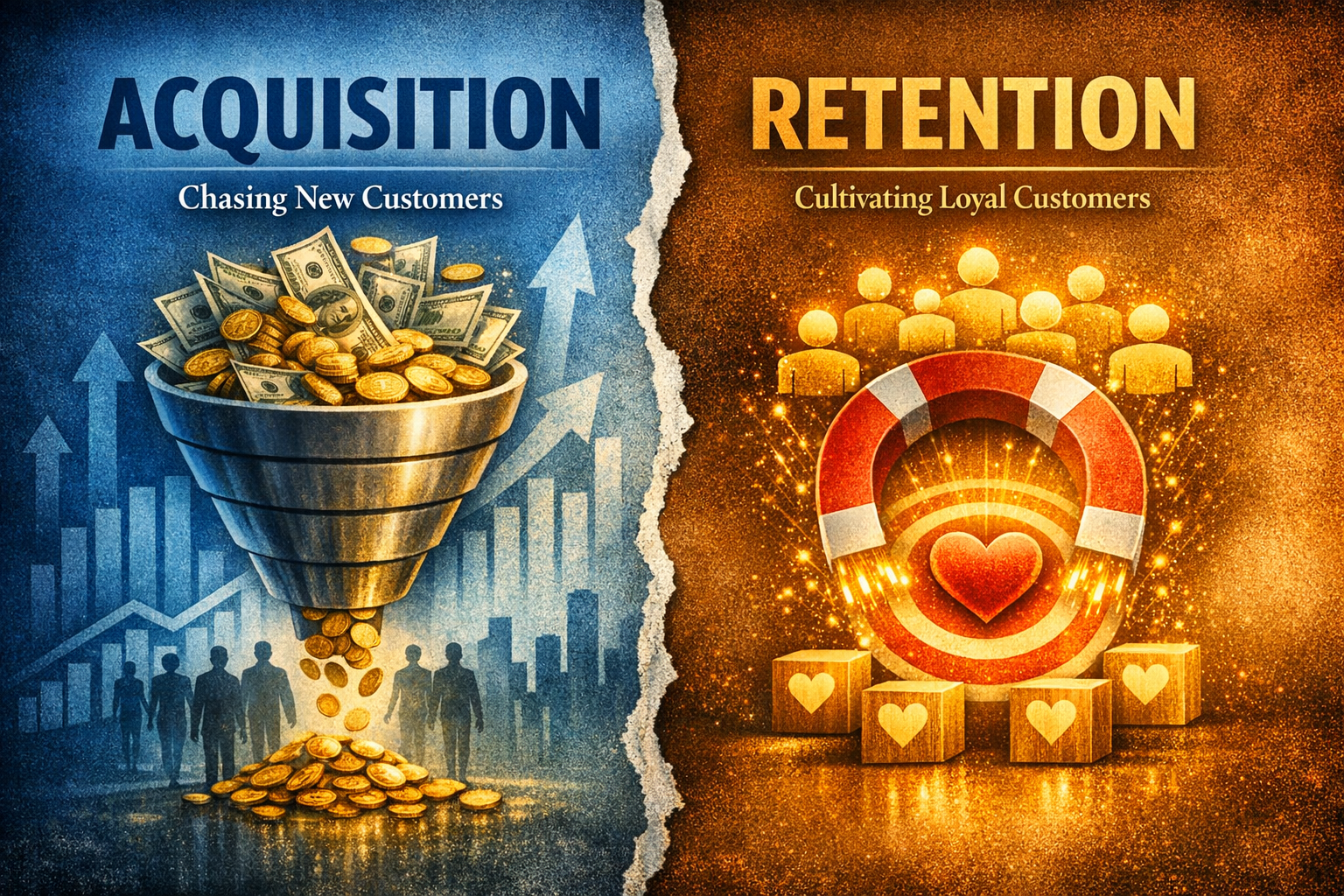
Why Customer Retention Outperforms Acquisition: The Hidden Growth Engine Most Businesses Ignore
Walk into almost any marketing meeting and you’ll hear the same vocabulary repeated with a kind of ritualistic certainty. New leads. New traffic. New followers. New customers. The conversation tilts toward acquisition so naturally that it rarely occurs to anyone to question it. Growth is framed as a race to bring more people in, as if the business were a bucket that simply needs a stronger faucet.
But anyone who has ever tried to scale a company knows the truth is more complicated. The bucket leaks. Sometimes slowly, sometimes at a rate that makes the faucet irrelevant. Yet the obsession with acquisition persists, even when the economics of retention are far more compelling. It’s a paradox that has shaped entire industries, and it continues to drain budgets, distort priorities, and limit the potential of businesses that could be thriving.
The irony is that the data has been clear for decades. Retention is where the real money is. It always has been. But the gravitational pull of acquisition is strong, and breaking free from it requires a shift in mindset that many companies never make.
This is the story of why businesses chase the wrong metric, what it costs them, and how the companies that prioritize retention quietly outperform everyone else.
The Seduction of Acquisition
Acquisition is easy to measure. It produces numbers that look impressive in a slide deck. It gives executives something to point to when investors ask about momentum. It feels like progress, even when it isn’t.
There’s also a psychological component. Humans are wired to chase novelty. New customers feel like new wins. They create a sense of forward motion. Retention, by contrast, is quieter. It doesn’t announce itself. It doesn’t spike charts. It doesn’t give you the same dopamine hit.
But the biggest reason acquisition dominates is structural. Most marketing teams are built around it. Most agencies sell it. Most tools are designed to optimize it. Entire ecosystems exist to help companies find new customers, while far fewer exist to help them keep the ones they already have.
The result is a kind of institutional bias. Businesses end up spending the majority of their budgets on the most expensive part of the customer lifecycle, while the most profitable part receives only a fraction of the attention.
The Economics of Retention
If acquisition is the flashy front door, retention is the foundation. It’s not glamorous, but it’s what keeps the house standing.
A retained customer buys more often. They spend more per transaction. They are less price‑sensitive. They refer others. They require less marketing. They create stability in revenue forecasts. They give you the breathing room to experiment, innovate, and grow.
The financial impact is so significant that even small improvements in retention can transform a business. A modest increase in repeat purchase rate can outperform a massive increase in new customer volume. Yet many companies never see this because they’re too busy chasing the next click.
Retention is not just a metric. It’s a multiplier. It amplifies every other part of the business. When retention is strong, acquisition becomes more efficient. When retention is weak, acquisition becomes a treadmill that never stops.
Why Retention Gets Ignored
If retention is so powerful, why do so many companies neglect it? The reasons are rarely malicious. They’re structural, cultural, and sometimes emotional.
Retention is harder to attribute
Acquisition has clean attribution. You can see where a lead came from. You can track the cost. You can calculate the return. Retention is messier. It’s influenced by product quality, customer experience, support interactions, brand perception, and dozens of subtle touchpoints that don’t fit neatly into a dashboard.
Retention requires cross‑functional alignment
You can run acquisition from a single department. Retention requires collaboration across marketing, product, operations, and support. It forces teams to talk to each other. Many organizations aren’t built for that.
Retention exposes weaknesses
Focusing on retention means confronting the reasons customers leave. That can be uncomfortable. It’s easier to pour money into acquisition than to fix the underlying issues that cause churn.
Retention is long‑term
Acquisition produces immediate results. Retention compounds over time. In a world driven by quarterly targets, long‑term thinking often loses.
The Companies That Get It Right
The businesses that dominate their industries rarely do so through acquisition alone. They win because they create ecosystems that customers don’t want to leave.
Think about the brands that inspire loyalty. They don’t rely on constant promotions or aggressive advertising. They build relationships. They create experiences that feel personal. They make customers feel understood.
Their retention strategies are not afterthoughts. They are core to the business model.
They invest in onboarding that reduces friction. They design products that reward continued use. They build communities that reinforce belonging. They treat support as a value driver rather than a cost center. They measure success not by how many people they attract, but by how many they keep.
These companies grow steadily, predictably, and profitably. They don’t need to chase acquisition because their customers do it for them.
The Hidden Cost of Churn
Churn is often treated as a background metric, something to monitor but not something to obsess over. In reality, churn is one of the most destructive forces in business.
Every lost customer represents not just lost revenue, but lost potential. It’s the loss of future purchases, referrals, and loyalty. It’s the loss of the investment you made to acquire that customer in the first place. It’s the loss of the compounding effect that retention creates.
Churn is a silent tax. It erodes growth from the inside. It forces companies to spend more on acquisition just to stay in place. It creates volatility in revenue that makes planning difficult. It undermines confidence.
The companies that treat churn as a strategic priority outperform those that treat it as an operational detail.
Retention as a Competitive Advantage
In crowded markets, differentiation is hard. Products can be copied. Features can be replicated. Prices can be matched. But relationships are difficult to duplicate.
Retention creates a moat. It builds a customer base that is resilient to competition. It gives you the freedom to innovate without fear of losing your audience. It allows you to grow without relying on increasingly expensive acquisition channels.
Retention is not just a marketing strategy. It’s a business strategy. It shapes product decisions, customer experience, and long‑term vision. It forces companies to think about value in a deeper way.
When retention becomes a priority, everything else improves. The product gets better. The support gets better. The communication gets better. The culture gets better. Retention is not a department. It’s a philosophy.
What a Retention‑Focused Business Looks Like
A company that prioritizes retention behaves differently. It listens more closely. It invests in understanding customer behavior. It treats feedback as a gift rather than a nuisance. It designs experiences that reward loyalty.
It doesn’t rely on gimmicks or discounts. It builds trust. It communicates clearly. It sets expectations and meets them. It creates moments that feel personal and meaningful.
Retention‑focused businesses don’t chase customers. They attract them and keep them by delivering consistent value. They understand that loyalty is earned, not bought.
The Shift That Changes Everything
The moment a company shifts its focus from acquisition to retention, the entire trajectory changes. Growth becomes more stable. Revenue becomes more predictable. Marketing becomes more efficient. Teams become more aligned. Customers become more engaged.
It’s not a small shift. It’s a fundamental reorientation of how a business thinks about value, success, and growth.
Acquisition will always matter. But acquisition without retention is a treadmill. Retention turns growth into something sustainable.
The companies that understand this are the ones that thrive, even in uncertain markets. They build businesses that last.